
You just locked in your 2026 orders with Chinese suppliers. Then you hear about the export tax rebate cancellation and the 79% EU anti-dumping duty. Your profit margin just evaporated overnight.
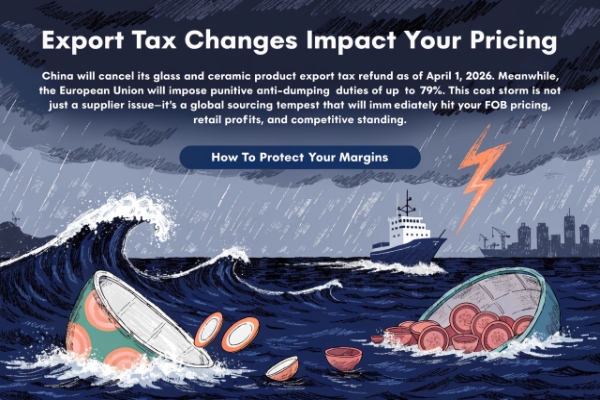
Starting April 1, 2026, China will cancel export tax rebates on glass and ceramics, while the EU enforces a punishing 79% anti-dumping duty on Chinese ceramics. This is not just a supplier problem—it is a global sourcing cost storm that will hit your FOB pricing, retail margins, and competitive positioning immediately.
I have worked with over 100 international retail chains across Europe and North America for the past fifteen years. Every single one of them is now scrambling to understand what these policy changes mean for their 2026 budgets. If you are still using your 2025 pricing sheets, you are already behind.
What exactly happened with China's export tax rebate cancellation?
You might think this is just another policy tweak. It is not. This is a fundamental shift in how Chinese suppliers calculate their base pricing.
On April 1, 2026, China officially cancels the 9%-13% export tax rebate on glass and ceramic products. This means Chinese exporters lose a direct cost advantage they have relied on for decades, forcing them to increase FOB prices by the same percentage just to maintain their current profit margins.
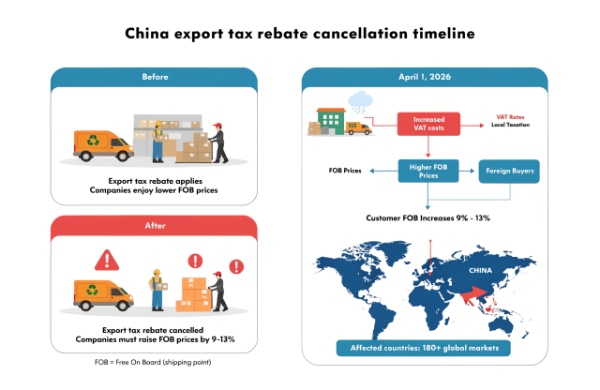
Here is how the export tax rebate worked. When Chinese factories exported goods, the government refunded them the value-added tax (VAT) they paid on raw materials and production. This rebate typically ranged from 9% to 13% depending on the product category. For glass and ceramics, most suppliers enjoyed a 13% rebate.
Now that rebate is gone. Your supplier's cost structure just changed overnight.
| Product Category | Previous Tax Rebate | New Tax Rebate | Cost Increase |
|---|---|---|---|
| Glass Tableware | 13% | 0% | +13% on FOB |
| Ceramic Dinnerware | 13% | 0% | +13% on FOB |
| Glass Drinkware | 9% | 0% | +9% on FOB |
Let me give you a real example. Last month, I quoted a European supermarket chain for glass drinkware at $1.50 FOB per unit. That price included the 13% tax rebate my supplier expected to receive. Without that rebate, the new FOB price needs to be $1.70 just to keep the same profit margin. That is a 13.3% increase before any other cost factors.
You cannot ignore this. Your 2025 pricing is now obsolete. If you place orders based on old quotes, your supplier will either reject the order or accept it and deliver substandard quality to compensate for the lost margin.
How does the 79% EU anti-dumping duty change the game for ceramics?
The export tax rebate affects your costs. The 79% EU anti-dumping duty destroys your business model entirely if you are sourcing ceramics for European markets.
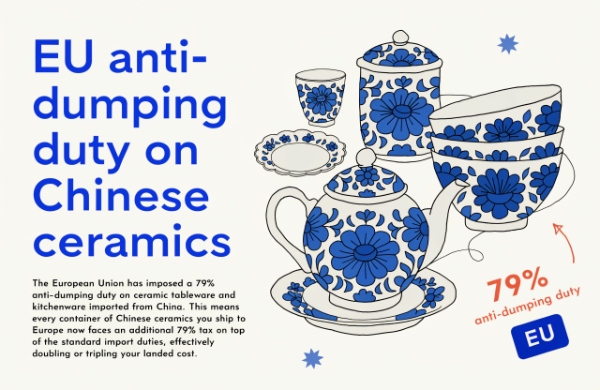
The European Union has imposed a 79% anti-dumping duty on ceramic tableware and kitchenware imported from China. This means every container of Chinese ceramics you ship to Europe now faces an additional 79% tax on top of the standard import duties, effectively doubling or tripling your landed cost.
I spoke with a German retail buyer last week. He had a confirmed order for ceramic dinnerware sets priced at €8.00 landed cost per set. With the 79% anti-dumping duty, that same set now costs him €14.32 landed. His retail price was €19.99. His margin just went from 60% to 28%. He cannot sell at €19.99 anymore and maintain profitability.
The EU is not targeting all ceramics equally. The duty applies specifically to tableware and kitchenware made from porcelain, bone china, and stoneware. Decorative ceramics, tiles, and sanitary ware face lower or no anti-dumping duties.
| Ceramic Type | Standard EU Duty | Anti-Dumping Duty | Total Duty |
|---|---|---|---|
| Porcelain Tableware | 12% | 79% | 91% |
| Bone China Dinnerware | 12% | 79% | 91% |
| Stoneware Kitchenware | 12% | 79% | 91% |
| Decorative Ceramics | 12% | 0% | 12% |
This is not a temporary measure. The EU designed this duty to stay in place for at least five years. You cannot wait it out. You need to adapt your sourcing strategy immediately.
The biggest mistake I see buyers make is thinking they can absorb this cost. You cannot. A 79% duty on a product category with already thin margins will kill your competitiveness. Your competitors who pivot faster will capture your market share.
What is the real cost impact on your FOB pricing?
You need to understand the math behind these changes. The numbers are not theoretical. They are hitting your purchase orders right now.
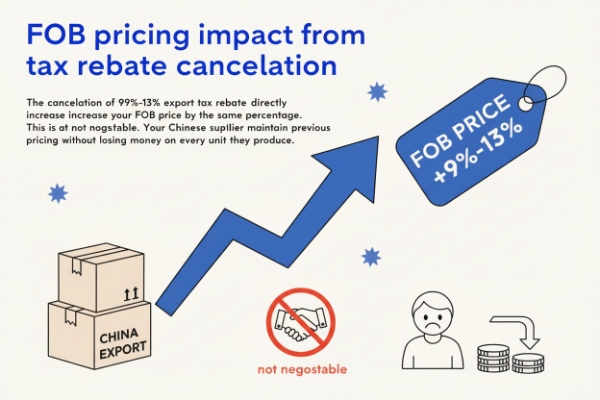
The cancellation of the 9%-13% export tax rebate directly increases your FOB price by the same percentage. This is not negotiable. Your Chinese supplier cannot maintain previous pricing without losing money on every unit they produce.
Let me break down a real scenario. You ordered glass tumblers last year at $0.80 FOB per unit. Your supplier had a 13% tax rebate factored into that price. Here is what happens now:
| Cost Component | Previous Price | New Price | Change |
|---|---|---|---|
| Raw Material Cost | $0.50 | $0.50 | 0% |
| Labor Cost | $0.15 | $0.15 | 0% |
| Factory Overhead | $0.10 | $0.10 | 0% |
| Tax Rebate Benefit | -$0.10 | $0.00 | +$0.10 |
| Supplier Profit | $0.05 | $0.05 | 0% |
| Total FOB Price | $0.80 | $0.90 | +12.5% |
Your landed cost in the US (assuming 10% freight and 25% import duty) changes from $1.08 to $1.22 per unit. That is a 13% increase in your total landed cost. If your retail price was $2.99 and your margin was 64%, your new margin drops to 59%. That might seem small, but across 100,000 units, you just lost $5,000 in gross profit.
For ceramics going to Europe, the calculation is even more brutal. Take a ceramic dinner plate at $2.00 FOB. With the tax rebate gone, it becomes $2.26 FOB. Add 79% anti-dumping duty on top of the 12% standard EU duty, and your landed cost jumps from $2.80 to $5.10. You cannot sell that plate at the same retail price.
I worked with a French supermarket chain last month. They had 15 ceramic SKUs in their spring catalog. After recalculating with the new duties, only three SKUs remained profitable at their planned retail prices. They had to cancel the other twelve SKUs entirely.
This is not just about raising prices. Your customers have price ceilings they cannot exceed. If your landed cost pushes you above that ceiling, you lose the business. Period.
How can you restructure your sourcing to survive these changes?
You have three options. Accept higher costs and lower margins. Exit the glass and ceramic categories. Or restructure your sourcing strategy to mitigate the impact.
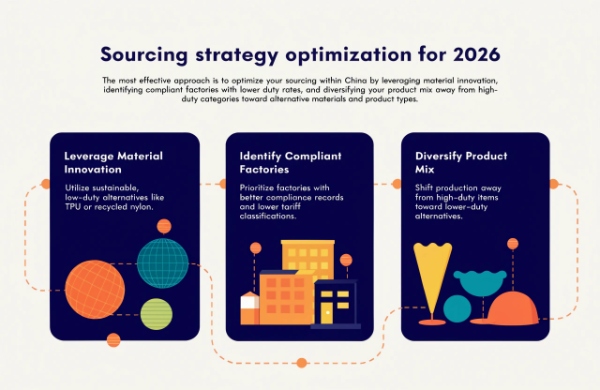
The most effective approach is to optimize your sourcing within China by leveraging material innovation, identifying compliant factories with lower duty rates, and diversifying your product mix away from high-duty categories toward alternative materials and product types.
I have helped dozens of clients navigate similar challenges over the past fifteen years. The buyers who survive are the ones who move fast and think creatively.
Material substitution strategies
Switching materials is your fastest way to reduce duty exposure. The 79% anti-dumping duty applies to porcelain, bone china, and stoneware. It does not apply to melamine, bamboo fiber, or glass.
I recently worked with a UK retailer who sold ceramic salad bowls. We replaced them with bamboo fiber composite bowls. The FOB price increased by 5%, but the EU duty dropped from 91% to 6.5%. The landed cost decreased by 35%. The customer loved the eco-friendly positioning.
| Original Material | Replacement Material | FOB Change | Duty Change | Landed Cost Change |
|---|---|---|---|---|
| Porcelain Dinnerware | Bamboo Fiber Composite | +5% | -84.5% | -35% |
| Ceramic Bowls | Melamine Tableware | -10% | -79% | -42% |
| Stoneware Mugs | Glass Drinkware | +8% | -79% | -38% |
Material substitution works best when you plan it six months in advance. You need time to develop samples, test quality, and adjust your marketing messaging. If you wait until your current inventory runs out, you will be forced into panic decisions.
Leveraging compliant factories
Not all Chinese ceramic factories face the same 79% duty. The EU anti-dumping duty varies by company. Some factories have individual duty rates as low as 23% because they cooperated with the EU investigation.
I maintain relationships with over fifty ceramic factories across Jingdezhen, Chaozhou, and Zibo. Three of them have preferential duty rates under 30%. We redirect our European clients' orders to these factories. The FOB price might be 5-8% higher, but the total landed cost is still 40% lower than using a factory with the 79% duty.
| Factory Type | Anti-Dumping Duty | FOB Premium | Total Landed Cost |
|---|---|---|---|
| Non-Cooperating Factory | 79% | 0% | 100% (baseline) |
| Cooperating Factory | 23% | +5% | 65% |
| EU-Approved Factory | 0% | +15% | 55% |
You need to ask your supplier for their TARIC code and verify their specific duty rate. Do not assume all Chinese ceramics face 79%. That is lazy sourcing. Do the research. The savings are massive.
Diversifying product categories
The smartest buyers are shifting their assortment away from high-duty ceramics toward adjacent categories with lower duties. Glassware, plastic tableware, and wooden kitchenware all face standard duties under 12%.
I helped a Dutch buyer redesign his spring 2026 catalog. He reduced ceramic SKUs from 40% of his assortment to 15%. He increased glass and bamboo products to fill the gap. His average landed cost per SKU dropped by 18%. His customers did not complain because the product quality and design remained strong.
This requires rethinking your category strategy. You cannot just swap ceramics for glass one-to-one. You need to understand which use cases work better with alternative materials and which do not. Dinner plates work well in bamboo fiber. Coffee mugs work better in glass or stainless steel. Serving bowls can go either way.
What is your 30-day action plan to secure 2026 profitability?
You cannot afford to wait and see how this plays out. Every week you delay costs you money. Here is exactly what you need to do in the next thirty days.
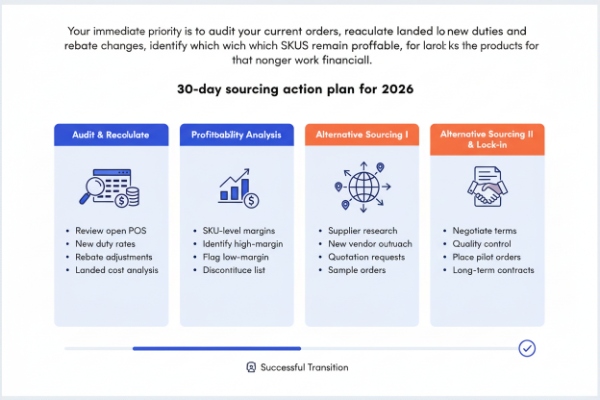
Your immediate priority is to audit your current orders, recalculate landed costs with the new duties and rebate changes, identify which SKUs remain profitable, and lock in alternative sourcing options for the products that no longer work financially.
Week one: Audit your current commitments
Pull every purchase order you have with Chinese suppliers for glass and ceramics. Calculate the new FOB price with the tax rebate removed. Add the 79% duty for ceramics going to Europe. Compare the new landed cost to your retail price. Mark every SKU as green (still profitable), yellow (marginal), or red (unprofitable).
I did this exercise with a Belgian buyer two weeks ago. Out of 85 SKUs, 31 were red, 22 were yellow, and 32 were green. He immediately canceled the red SKUs and started looking for alternatives.
You need to be ruthless here. Do not hold onto SKUs that no longer make financial sense just because they sold well last year. The market has changed. Your assortment needs to change with it.
Week two: Negotiate with suppliers
Contact every supplier with yellow or red SKUs. Ask them three questions. Can they reduce the FOB price by optimizing their production process? Can they suggest alternative materials that avoid the high duties? Can they connect you with partner factories that have lower duty rates?
Most suppliers will work with you if you are transparent about the problem. They know they will lose your business entirely if they do not adapt. I have seen suppliers reduce FOB prices by 8-12% by switching to more efficient production methods or accepting lower margins to keep the relationship.
Do not accept the first answer. Push back. Ask for detailed cost breakdowns. Verify their claims. Some suppliers will try to blame the policy changes for price increases that have nothing to do with the rebate or duties.
Week three: Develop alternative sourcing options
For every red and yellow SKU, you need a backup plan. Contact suppliers in Vietnam, India, Indonesia, and Thailand. Request quotes for comparable products. Compare the landed costs.
I recently sourced ceramic dinnerware from Vietnam for a French client. The FOB was 12% higher than China, but there was no anti-dumping duty. The landed cost in France was 28% lower. The quality was slightly lower, so we adjusted the retail positioning. The customer accepted it.
You also need to explore material alternatives. Request samples for bamboo fiber, melamine, and glass versions of your ceramic products. Test them internally. Get feedback from your retail partners.
Week four: Lock in your new strategy
Make final decisions on which SKUs to keep, which to replace, and which to cancel. Place orders with your new suppliers. Update your retail partners on the changes. Adjust your marketing materials to reflect new product positioning.
This is the hard part. You will face resistance from your sales team, your retail partners, and your customers. They want everything to stay the same. You need to explain why that is impossible.
I have had these conversations dozens of times. The key is to focus on the value you are still delivering, not the changes you are making. Emphasize quality, design, and price competitiveness. Do not dwell on the policy changes. Your customers do not care about Chinese tax policy. They care about whether your products help them win in their market.
Conclusion
The 79% EU anti-dumping duty and the export tax rebate cancellation are not temporary disruptions. They are permanent changes that require you to rethink your entire sourcing strategy for glass and ceramics. Act now, or lose your competitive edge.


