
I've had three clients defer orders this quarter because they saw shipping quotes double overnight. They all asked the same question: "Should we wait until rates drop?" But that framing misses the actual decision they need to make.
Global shipping rates have spiked due to capacity shortages, rerouted vessels avoiding conflict zones, and seasonal demand surges combining at once. But whether this affects your order depends on your product's value density, shipping route flexibility, and whether your volume qualifies for consolidated pricing—not just the headline rate itself.
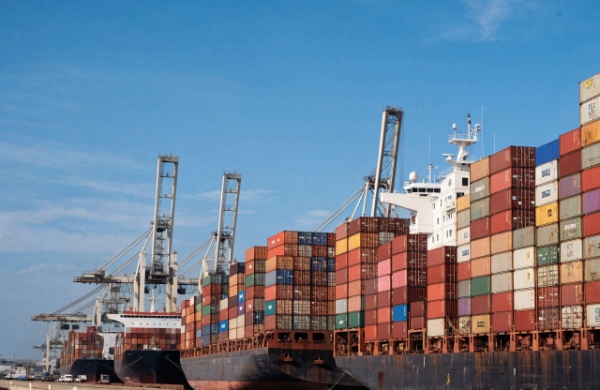
The real question isn't "why are rates high" but "does this rate increase eliminate my margin, or can I adjust the shipping approach to keep the order viable?" Let me walk you through what I check with clients when they face this exact situation.
What specific factors are pushing rates up right now?
I get calls every week asking if rates will drop next month. The truth is I can't predict that—but I can tell you which factors are creating the current environment, so you know what variables to monitor.
Three overlapping pressures are hitting at once: carriers avoiding Red Sea routes and adding 10-14 days to Asia-Europe transit, port congestion creating equipment shortages in key export hubs, and seasonal volume peaks absorbing available capacity. These aren't temporary disruptions that resolve in weeks—they shift how carriers allocate space.
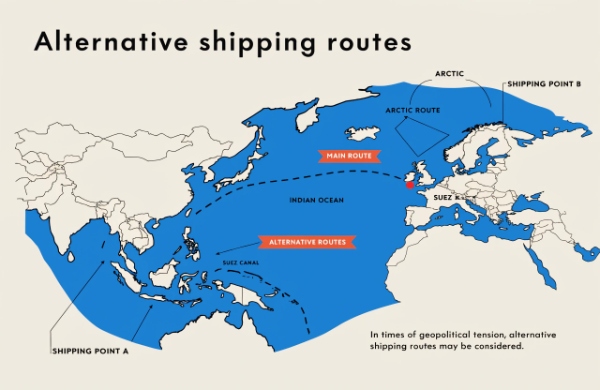
Carriers rerouted around the Cape of Good Hope starting in late 2023 due to attacks in the Red Sea corridor. That added two weeks to Europe-bound shipments. Longer voyages mean each vessel completes fewer annual trips, which reduces total capacity without any ships being retired. At the same time, port congestion in major Chinese export hubs like Ningbo and Shanghai created equipment imbalances—empty containers ended up in the wrong locations, so even if space exists on a vessel, boxes aren't always available where cargo originates.
Then the seasonal layer: Chinese New Year front-loading, peak retail inventory builds, and contract renewals all hit between January and March. When baseline capacity is already constrained, seasonal demand doesn't just raise prices—it eliminates access entirely for spot bookings below certain volumes.
Here's how these variables interact in practice:
| Factor | Impact on Your Order | What to Check |
|---|---|---|
| Route diversions | 10-14 day transit extension, higher fuel surcharges | Ask your supplier if alternate routes (Suez if reopened, or direct trans-Pacific if serving US) apply to your destination |
| Equipment shortages | Space confirmed but no container allocated until 72 hours before cut-off | Verify supplier has pre-booked equipment, not just vessel space |
| Seasonal volume peaks | Minimum volume thresholds for allocation increase | Check if your order size qualifies for consolidated shipment with other buyers |
| Contract vs. spot pricing | Contract shippers get priority; spot rates fluctuate 20-40% week-to-week | Ask if supplier has contract rates or must use spot market for your shipment |
I had a client shipping ceramic tableware to Germany who saw their quote jump from $3,200 to $6,800 for a 40HQ container in February. The cause wasn't a universal rate increase—it was the combination of Red Sea avoidance (adding the Cape route), CNY front-loading (reducing available slots), and their order falling below the 15-container threshold that would have qualified them for contract pricing. When we shifted the shipment to late March and consolidated with another buyer's order, the rate dropped to $4,100—not because "rates fell" but because we changed the variables that determined their pricing tier.
The lesson: don't treat "rates are high" as a binary condition. Rates are high relative to a specific route-timing-volume combination. If you can adjust any of those three variables, you may find pricing that preserves your margin without waiting for a market-wide correction that may not come.
Should I wait for rates to drop or lock my order now?
Every client facing a doubled shipping quote asks this. I can't predict rate movements—but I can show you which factors determine whether waiting or locking makes sense for your specific order.
The decision depends on three variables you control: whether your product value density can absorb the premium, if your shipment timing is flexible enough to target lower-demand windows, and whether your order volume qualifies for consolidation that offsets rate increases. Waiting only makes sense if all three work against you now but improve in your target timeframe.
Start by calculating shipping as a percentage of your landed cost. If you're importing high-value-density products—electronics, small appliances, branded goods with $15+ retail price points—a $3,000 container rate increase on a $45,000 product value adds 6.7% to your landed cost. That's painful but rarely order-killing. If you're importing low-value-density products—bulky home goods, large plastic items, products retailing under $5—that same $3,000 increase on a $12,000 product value adds 25% to landed cost. That eliminates margin entirely.
I worked with a buyer importing storage bins (low value density, $2-3 retail) and another importing stainless steel kitchen tools (higher value density, $12-18 retail). Both faced the same $2,800 rate increase. For the storage bin buyer, that increase made the order unviable—they deferred. For the kitchen tool buyer, the increase reduced margin from 38% to 31%, which was acceptable—they proceeded. Same rate, opposite decisions, because value density determined whether the premium was absorbable.
Next, check timing flexibility. Shipping rates don't move uniformly—they vary by booking window relative to demand peaks. If your order must arrive before a specific retail deadline (back-to-school, Black Friday, holiday), you have no timing flexibility, which means you either accept current rates or cancel. If your order supports ongoing inventory replenishment with 60-90 days of flexibility, you can target lower-demand windows—typically late March through May and September through early October, when seasonal surges subside and carriers need to fill capacity.
Finally, evaluate volume leverage. Minimum thresholds for contract pricing and consolidation eligibility shift during high-rate periods. A 3-container order that normally qualifies for consolidated LCL-to-FCL conversion may fall below the threshold when carriers prioritize 10+ container bookings. Ask your supplier: "At what volume does pricing improve, and can we combine with other orders to reach that threshold?"
Here's the decision framework I use with clients:
| Your Situation | Action | Reason |
|---|---|---|
| High value density + timing flexibility + volume below threshold | Consider waiting 4-6 weeks, then recheck | Rate premium is absorbable but timing flexibility lets you target lower-demand window where consolidation may become available |
| High value density + fixed deadline + any volume | Lock now | Margin can absorb premium and delay creates delivery risk that outweighs potential savings |
| Low value density + timing flexibility + volume at/above threshold | Lock now but negotiate consolidated pricing | Premium erases margin but volume leverage exists—use it before deferring |
| Low value density + fixed deadline + volume below threshold | Defer or cancel | Premium eliminates margin, no timing flexibility to target lower rates, no volume leverage to negotiate—order isn't viable under current conditions |
I had a US buyer importing holiday seasonal items (fixed October deadline) with low value density face a $4,200 rate increase in June. They had no timing flexibility and volume was only 2 containers. We couldn't consolidate and couldn't wait. They deferred the order entirely because the math didn't work. That same week, a buyer importing year-round kitchen gadgets (high value density, 90 days of timing flexibility) faced a similar increase. We pushed their shipment to August when seasonal volume dropped and consolidated with two other orders to hit a 6-container threshold. Their rate came in $1,800 lower than June pricing—not because rates "dropped" but because they controlled the variables that determined their tier.
The mistake is asking "will rates drop?" when you should be asking "which combination of timing, volume, and route gives me pricing I can work with?" If current conditions don't offer that combination and you have flexibility, waiting makes sense. If you have no flexibility or current pricing is absorbable, locking avoids the risk that conditions worsen instead of improving.
How can I tell if my supplier's shipping quote reflects actual costs or markup?
Clients ask this when they see quotes that seem disproportionate to market headlines. The concern is valid—but shipping quotes vary legitimately based on factors most buyers don't see.
Supplier shipping quotes reflect their own carrier contracts, volume tier, equipment access, and whether they're absorbing detention/demurrage risk. A quote that seems high compared to a headline rate may actually be lower than spot market pricing once you account for guaranteed space allocation and included surcharges. The question isn't "is this markup" but "what am I getting for this rate."
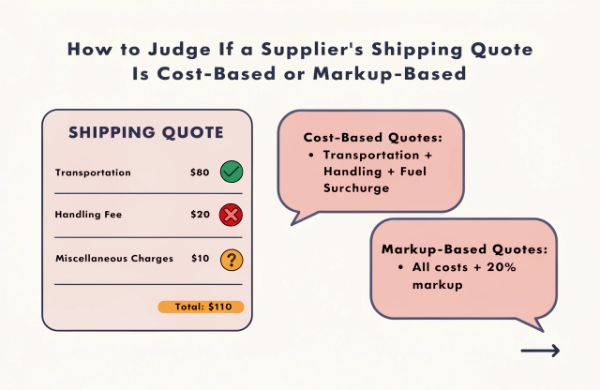
Freight rates you see in headlines—Shanghai Containerized Freight Index, Freightos Baltic Index—represent spot market averages across all carriers and volume tiers. Your supplier's quote reflects their specific situation: do they have contract rates with one carrier, must they book spot across multiple carriers to secure space, how many containers per month do they ship on your route, and what surcharges are included in the quoted figure.
I work with three different carriers depending on destination and volume. For Europe, we have a contract rate with one carrier that's $800 above headline index rates but includes guaranteed weekly space and covers detention/demurrage up to 5 days. For US West Coast, we use spot bookings across two carriers—rates fluctuate $600-900 week-to-week but we only pay base ocean freight; all surcharges bill separately. For Australia, we consolidate with a freight forwarder who combines multiple shippers' cargo—rate is $1,200 below index averages but requires 14-day advance booking and no schedule flexibility.
When a client questions a quote, I break down what's included:
| Rate Component | What It Covers | Why It Varies |
|---|---|---|
| Base ocean freight | Carrier's charge to move container from origin port to destination port | Varies by carrier contract vs. spot, volume tier, and route demand |
| Bunker adjustment factor (BAF/EBS) | Fuel cost surcharge | Fluctuates with oil prices; some suppliers include in quote, others list separately |
| Peak season surcharge (PSS) | Demand premium during high-volume periods | Applied inconsistently—some carriers charge $500-1500, others roll into base rate |
| Equipment imbalance charge | Fee for using container in deficit location | Only applies when exporting from locations with more imports than exports |
| Detention/demurrage coverage | Buffer for container return delays | Some suppliers include 5-7 day buffer; others pass through any charges |
| Origin handling charges | Trucking from factory to port, customs clearance, loading fees | Varies by supplier location and their logistics setup |
I quoted a client $5,800 for a 40HQ to Rotterdam in February. They found a forwarder quoting $4,200 and asked why our rate was $1,600 higher. I broke it down: our quote included guaranteed space (theirs was "subject to allocation"), 7-day detention coverage (theirs charged $75/day after 3 days), origin handling from our Yiwu warehouse to Ningbo port (theirs required client-arranged trucking), and our contract rate locked for 30 days (theirs was valid 72 hours). When they added the components their quote excluded, total cost came to $5,650—$150 less than ours, but with rollover risk if space wasn't allocated. They chose our quote because the certainty premium was worth $150 on a $38,000 order.
Ask your supplier: "What does this rate include, what bills separately, and what happens if I can't return the container within free time?" A quote that seems high but includes comprehensive coverage and guaranteed space may cost less than a low quote with exclusions and no allocation certainty. The reverse is also true—a high quote without clear inclusions may contain markup. You can't tell without asking for the breakdown.
If a supplier won't itemize their quote, that's a red flag. If they itemize and the total aligns with market conditions for their volume tier and route, trust that they're passing through actual costs. The goal isn't to find the absolute lowest quote—it's to find the quote that balances cost with delivery certainty for your order's timeline and margin requirements.
What alternatives exist if standard ocean freight is too expensive?
When standard rates eliminate margin, clients assume they must defer the order. But several workarounds exist depending on your product type and urgency.
If ocean freight exceeds your budget, check whether air freight's speed advantage allows higher retail velocity that offsets the premium, if rail freight to Europe offers mid-range pricing for non-urgent shipments, or if LCL consolidation reduces your minimum order quantity enough to preserve margin at lower total volume. The alternative that works depends on your product's value density and inventory turn rate.
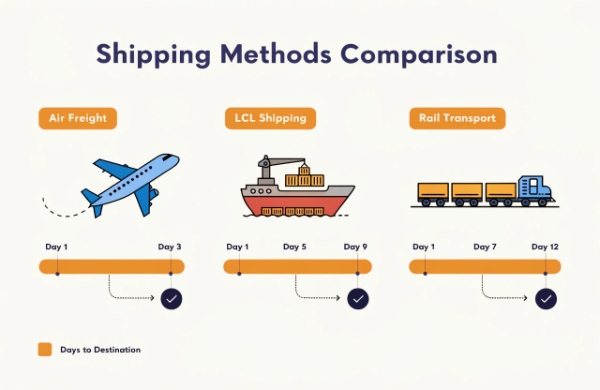
Air freight costs 4-6x more per kilo than ocean but delivers in 5-7 days versus 30-45 days. For high-value, fast-turning products, the premium disappears when you calculate margin per day. I had a client importing branded kitchen gadgets with 45-day inventory turn and 40% margin. Ocean freight was $6,800 (38-day transit), air freight was $18,500 (6-day transit). Ocean freight per day: $179. Air freight per day: $3,083. But air delivery allowed them to turn inventory 1.3 additional times during the period ocean shipment was in transit. At $28,000 product value and 40% margin, that extra turn generated $11,200 in additional margin—more than covering the $11,700 air premium. They switched to air for three months until ocean rates stabilized.
This only works for products with high value density (small, expensive items like electronics, tools, accessories) and high turn rates (restocked within 30-60 days of sale). For bulky, low-margin products with slow turn, air freight destroys economics entirely.
Rail freight to Europe offers a middle option. Transit time is 16-20 days (faster than ocean's 38-45 days via Cape route, slower than air's 5-7 days), and cost runs 50-70% above ocean but 75-85% below air. If your product has moderate urgency and can absorb a mid-tier premium, rail bridges the gap. I've used this for clients importing home textiles and small furniture to Germany when ocean rates spiked but air was unjustifiable. Rail worked because the products had moderate value density and retail timelines that allowed 20-day transit but penalized 45-day transit.
LCL consolidation reduces minimum order size when FCL becomes too expensive. If you normally ship 2-3 containers but current rates make that unviable, ask your supplier if LCL consolidated with other buyers brings per-unit cost down enough to preserve margin at lower volume. You'll sacrifice some unit economics compared to full container pricing, but you avoid holding inventory purchased at inflated freight costs.
Here's when each alternative makes sense:
| Alternative | Best For | Deal-Breaker |
|---|---|---|
| Air freight | High value density + fast inventory turn + urgent delivery | Bulky or low-margin products—premium exceeds margin gain from speed |
| Rail freight (Europe only) | Moderate value density + 30-60 day acceptable delivery window | Destinations outside Europe-Asia rail corridor—not available |
| LCL consolidation | Lower volume orders where FCL rates eliminate margin | Products requiring full container for MOQ—can't split shipment |
| Deferred shipment | Low value density + flexible timing + expectation rates will improve | Fixed retail deadlines—delay creates lost sales that exceed rate savings |
I had a buyer importing ceramic dinnerware (low value density, slow turn) who couldn't justify $7,200 ocean freight on a 2-container order. Air wasn't an option—too bulky. Rail wasn't available—they were shipping to US, not Europe. We used LCL consolidation to reduce their order from 2 containers to 18 cubic meters, which brought per-unit freight cost down 22% compared to their 2-container FCL rate. They accepted slightly worse unit economics in exchange for not carrying inventory purchased at peak rates.
Don't assume standard ocean FCL is your only option. But also don't assume alternatives automatically work—each has specific conditions where economics make sense. Ask your supplier: "At what order size does LCL become viable, what's your rail freight access if I'm shipping to Europe, and does my product's value density support air freight if urgency increases?"
How should I discuss shipping costs with my supplier?
Clients often approach shipping cost conversations as negotiations—trying to push suppliers to absorb increases or find cheaper carriers. That framing usually fails because suppliers operate under the same external constraints you do.
**Productive shipping cost discussions focus on identifying which variables you can adjust together—timing, volume consolidation, equipment type, or route flexibility—rather than asking suppliers to lower their rate. Suppliers can't change carrier pricing but they can often repackage your shipment parameters to access better tiers. Frame the conversation as problem-solving, not price


